
How Suicide Loss Impacts the Nervous System: Understanding the Science Behind Grief, Trauma, and Healing
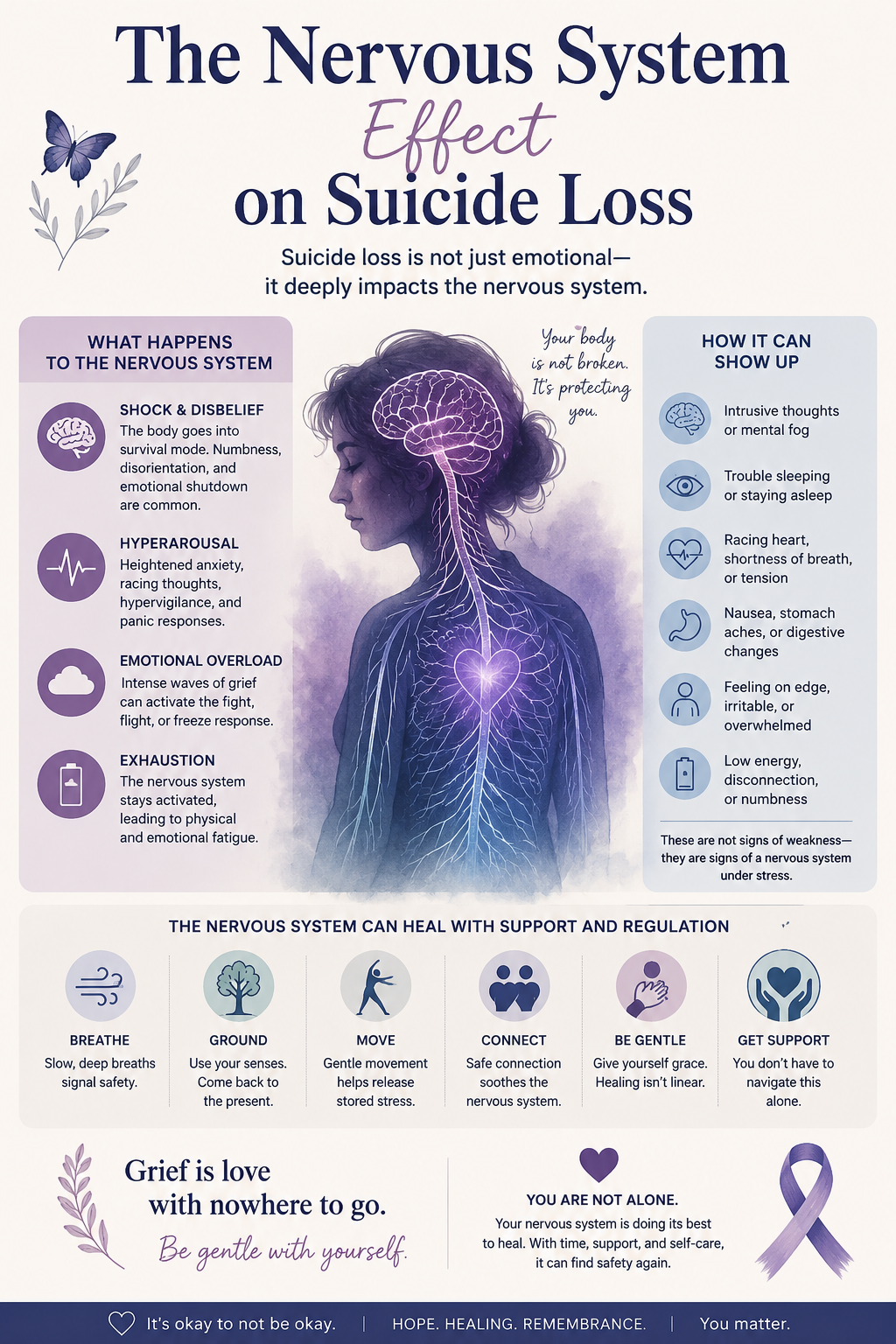
When most people think about grief, they think about emotions:
sadness, crying, heartbreak, longing.
But suicide loss often affects far more than emotions alone.
For many survivors, suicide loss becomes a full nervous system experience.
This is one reason survivors often say:
“I don’t feel like myself anymore.”
Because traumatic grief does not only impact the heart.
It impacts the brain, body, nervous system, sense of safety, and the way a person experiences the world.
Suicide Loss Is Often Both Grief and Trauma
Grief and trauma are not the same thing.
Grief is the natural emotional response to losing someone we love.
Trauma occurs when the nervous system experiences something overwhelming that exceeds our ability to process, cope, or feel safe.
Suicide loss often contains both.
In fact, many mental health professionals recognize that losing a loved one to suicide can create symptoms associated with Complex Post-Traumatic Stress (C-PTSD), especially when the loss involves prolonged shock, intrusive thoughts, guilt, nervous system dysregulation, emotional overwhelm, or repeated retraumatization through stigma and unanswered questions.
Many survivors experience:
shock,
panic,
intrusive images,
hypervigilance,
emotional numbness,
sleep disruption,
anxiety,
guilt,
fear,
and profound loss of safety.
For some, the nervous system never fully feels “settled” again after the loss.
This is not weakness.
It is biology.
Suicide Loss Can Shatter a Person’s Sense of Safety
Research has shown that traumatic grief can affect the nervous system in ways comparable to — and for some people even more intensely than — other major traumatic experiences.
One reason suicide loss can feel especially destabilizing is because it violates our subconscious assumptions about life, safety, and human behavior.
Soldiers who go to war are trained for danger. They understand they may witness death, trauma, or violence. Their nervous systems are prepared — at least to some degree — for the possibility of life-threatening experiences.
But most people are never psychologically prepared for the possibility that someone they deeply love could die by suicide.
I knew what suicide was. Most people do.
But I never imagined it would happen to someone I loved.
From early childhood, many of us are subconsciously taught:
old people die,
sick people die,
accidents happen,
tragedy happens “out there.”
But we are generally not taught that someone we love could die by their own hand.
So when suicide loss happens, it can completely shatter a person’s internal sense of predictability and safety in the world.
The nervous system often responds with:
“If this could happen… what else is possible?”
For many survivors, the world no longer feels safe, stable, or understandable after the loss.
The Nervous System Is Designed to Protect You
The nervous system’s primary job is survival.
Your brain and body are constantly scanning:
“Am I safe?”
After a traumatic loss, especially suicide loss, the nervous system may begin perceiving the world as unsafe.
This can create chronic activation of survival states such as:
fight,
flight,
freeze,
or collapse/shutdown.
Survivors may not even realize they are living in survival mode because it becomes their new normal.
Common Nervous System Symptoms After Suicide Loss
Many survivors struggle with symptoms they never expected after grief.
These may include:
Hypervigilance
Feeling constantly on edge or waiting for something bad to happen.
Anxiety and Panic
A persistent sense of fear, dread, or nervous system overload.
Exhaustion
Traumatic grief is physically draining. Many survivors experience deep fatigue that sleep does not fix.
Brain Fog
Difficulty concentrating, remembering things, making decisions, or processing information.
Emotional Numbness
Some survivors stop feeling emotions altogether for periods of time. This is often protective, not pathological.
Sleep Disturbances
Insomnia, nightmares, waking in panic, or difficulty feeling safe enough to rest.
Isolation
The nervous system may begin withdrawing from people, noise, stimulation, or social interaction as a form of protection.
Sensitivity to Triggers
Dates, sounds, locations, conversations, hospitals, sirens, or even certain songs can trigger nervous system responses long after the loss.
Many survivors quietly wonder:
“Why am I reacting this way years later?”
Because the body remembers trauma even when the mind tries to move forward.
Shame and Stigma Intensify Nervous System Dysregulation
One of the most overlooked aspects of suicide loss is stigma.
Many survivors feel:
judged,
misunderstood,
abandoned,
or emotionally unsafe discussing the loss.
Some people avoid the topic entirely. Others ask intrusive questions or offer simplistic explanations.
The nervous system interprets shame and social rejection as threats.
So when survivors feel unsupported or isolated, the body often stays in survival mode even longer.
Healing Is Not Just Emotional — It Is Physiological
This is why many survivors cannot simply “think” their way out of traumatic grief.
Healing after suicide loss often requires helping the nervous system experience safety again.
This may include:
nervous system regulation,
trauma-informed support,
safe connection,
gentle movement,
breathwork,
grounding practices,
therapy,
support groups,
somatic healing,
mindfulness,
rest,
and compassionate community.
For many survivors, healing begins the moment they realize:
“My reactions make sense.”
Not because they are broken.
But because their nervous system has been through something overwhelming.
You Are Not Crazy. You Are Responding to Trauma.
One of the most important things survivors need to hear is this:
If you feel exhausted, disconnected, anxious, numb, overwhelmed, hypervigilant, or unlike yourself after suicide loss — your nervous system may be responding exactly as it was designed to after trauma.
Your body is not betraying you.
It is trying to protect you.
And while traumatic grief can profoundly affect the nervous system, healing is possible.
With the right support, many survivors slowly begin to:
feel safe again,
reconnect with others,
regulate emotions,
restore energy,
sleep more deeply,
and return to life without abandoning the person they lost.
Healing does not mean forgetting.
It means learning how to carry the grief with more support, more regulation, and less suffering in the body.
And most importantly:
You do not have to navigate this alone.
Gentle Ways to Support Your Nervous System After Suicide Loss
After traumatic grief, many survivors live in a constant state of nervous system activation without realizing it.
While no tool takes away the pain of loss, small moments of regulation can help the body begin to feel a little safer over time.
Here are a few gentle practices that many survivors find supportive:
Humming
Humming creates vibration that can help stimulate the vagus nerve, which plays an important role in calming the nervous system.
Even a few minutes of soft humming can sometimes help the body shift out of stress activation.
The Butterfly Hug
The Butterfly Hug involves gently crossing your arms over your chest and alternating soft tapping on each side of the body.
This bilateral stimulation can help create grounding, safety, and emotional regulation during overwhelming moments.
Walking in Nature
Nature has a regulating effect on the nervous system.
A slow walk outside — especially without pressure to “feel better” — can help reduce overwhelm, support breathing, and reconnect the body to the present moment.
Deep Exhales
Trauma often causes people to unconsciously hold their breath.
Slow, extended exhales can signal safety to the nervous system and help reduce stress activation.
Safe Human Connection
One of the most healing experiences for the nervous system is being with people who feel emotionally safe.
Even one supportive conversation where you feel understood can help reduce the isolation many survivors carry.
Healing after suicide loss is not about forcing yourself to “move on.”
It is about learning how to support a nervous system that has experienced profound shock, heartbreak, and trauma.
About the Author
Jayne Madigan is the Founder of Healing After Suicide, Author, Speaker, Retreat Facilitator, and Creator of the H.O.P.E.S. Method™. Having navigated the journey of suicide loss for more than 34 years after experiencing multiple suicide losses in her own life, Jayne has dedicated her work to helping suicide loss survivors move from surviving to healing.
Through her writing, workshops, retreats, and support programs, she helps survivors honor their grief, reconnect with hope, and discover that healing is possible—even after profound loss.
Learn more at HealingAfterSuicide.net.
Ready to Take the Next Step in Your Healing?
If you are navigating the loss of a loved one to suicide, you don't have to walk this journey alone.
Explore upcoming events, healing resources, and opportunities for connection and growth at HealingAfterSuicide.net.
Healing is possible. One day at a time.