
Why Losing Someone to Suicide Is So Traumatic: Understanding Grief Brain and the Science of Suicide Loss
Three years after my loved one died by suicide, I still wasn't "over it."
In fact, in many ways, I felt worse.
I remember wondering if something was wrong with me. Why was I still struggling when everyone around me seemed to think I should be moving on?
What I didn't understand at the time was that suicide loss is different.
Not because we loved our person more than others love theirs, but because suicide combines grief and trauma in a way that few other losses do.
Understanding the science behind suicide bereavement helped me realize that what I was experiencing was not weakness. It was a normal response to an extraordinarily traumatic event.
We Are Not Prepared for Suicide
As children, we learn that death is a part of life.
We are taught that elderly people die. We understand that people may die from illness, accidents, or natural causes. While these losses are painful, they fit within our understanding of how life works.
What we are not taught is that someone we love may die by their own hand.
Suicide shatters our assumptions about safety, relationships, love, and the future.
Suddenly we find ourselves asking questions that have no satisfying answers:
Why didn't I see the signs?
Could I have prevented it?
Why didn't they tell me how much they were hurting?
Did they know how much they were loved?
Why did this happen?
Unlike many other losses, suicide often leaves survivors carrying grief, trauma, guilt, anger, confusion, abandonment, and unanswered questions all at the same time.
Your Brain Goes Into Survival Mode
When a loved one dies by suicide, your brain doesn't simply process a loss.
It processes a trauma.
The moment we receive devastating news, our nervous system activates its survival response. Stress hormones such as cortisol and adrenaline flood the body. The brain shifts its focus from thriving to surviving.
This is why many suicide loss survivors experience:
Brain fog
Difficulty concentrating
Memory problems
Fatigue
Sleep disturbances
Emotional numbness
Anxiety
Feeling detached from reality
Many survivors describe this period as feeling like they are walking through a dense fog.
This experience has become commonly known as "grief brain."
What Is Grief Brain?
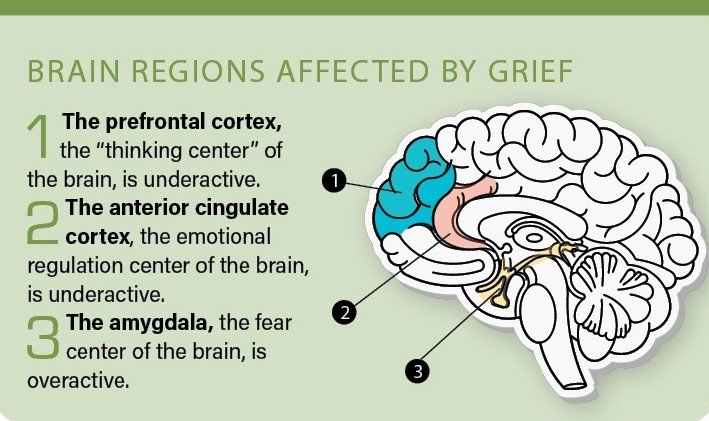
Grief brain is a very real neurological response to overwhelming loss.
When something traumatic happens, the brain prioritizes survival over higher-level thinking. Areas responsible for memory, concentration, decision-making, and emotional regulation simply do not function the same way they did before the loss.
Many survivors report:
Forgetting appointments
Losing their train of thought
Reading the same paragraph repeatedly
Walking into a room and forgetting why
Struggling to make simple decisions
Feeling disconnected from life
If this happened to you, you are not losing your mind.
Your brain is doing exactly what it was designed to do when faced with overwhelming trauma.
For many people, this fog lasts six to twelve months. Sometimes longer.
Why the Pain Often Gets Worse After the First Year
One of the most confusing parts of suicide grief is that many survivors feel worse after the first year than they did immediately after the death.
At first, shock protects us.
The brain cannot fully absorb the reality of what happened, so it gradually allows us to process the loss in manageable pieces.
Then something happens.
The fog begins to lift.
The casseroles stop arriving.
People stop checking in.
Life around us returns to normal.
And we are left facing a reality we may not have fully felt during the first year:
They are really gone.
Many survivors believe they are moving backward when this happens.
They aren't.
Often, this is the point where deeper healing begins.
The nervous system has stabilized enough to start processing what the shock initially protected us from.
Why Suicide Grief Often Takes Longer
Research has consistently found that suicide loss survivors frequently experience a longer and more complex grieving process than many other bereaved individuals.
That's because suicide grief is rarely just grief.
It often includes:
Trauma
Guilt
Self-blame
Anger
Shame
Stigma
Fear
Abandonment
Unanswered questions
Survivors often replay conversations, search for missed signs, and try to solve questions that may never have answers.
Many grief experts suggest that the healing journey following suicide loss often unfolds over five to seven years or longer.
That does not mean you will suffer intensely for seven years.
It means that healing from suicide loss happens in layers.
As one layer heals, another may emerge.
This is normal.
The Brain Can Heal
The encouraging news is that the brain is capable of healing.
Through a process called neuroplasticity, the brain can create new neural pathways and strengthen emotional resilience throughout our lives.
While we cannot erase the loss, we can help our nervous system recover from the trauma.
Research shows that practices such as:
EFT Tapping
Meditation
Journaling
Exercise
Time in nature
Support groups
Trauma-informed therapy
Breathwork
Meaningful connection
Consistent sleep
can help regulate the nervous system and support emotional healing.
These tools help move the body out of chronic survival mode and create the conditions necessary for healing.
If You're Still Struggling Years Later
I want you to hear this:
There is nothing wrong with you.
You are not broken.
You are not failing at grief.
You experienced one of the most devastating losses a human being can experience.
The depth of your pain reflects the depth of your love.
Healing from suicide loss is not about forgetting the person you lost.
It is not about "getting over it."
It is about learning how to carry both grief and love at the same time.
Over time, the waves become less overwhelming.
You begin to breathe a little easier.
You discover moments of peace.
Then moments of joy.
Eventually, you realize something important:
You can miss them deeply and still live fully.
You can carry grief and joy together.
And perhaps that is one of the greatest acts of love we can offer those we have lost—to continue living, healing, and finding meaning, one day at a time.
About the Author
Jayne Madigan is the Founder of Healing After Suicide, Author, Speaker, Retreat Facilitator, and Creator of the H.O.P.E.S. Method™. Having navigated the journey of suicide loss for more than 34 years after experiencing multiple suicide losses in her own life, Jayne has dedicated her work to helping suicide loss survivors move from surviving to healing.
Through her writing, workshops, retreats, and support programs, she helps survivors honor their grief, reconnect with hope, and discover that healing is possible—even after profound loss.
Learn more at HealingAfterSuicide.net.
Ready to Take the Next Step in Your Healing?
If you are navigating the loss of a loved one to suicide, you don't have to walk this journey alone.
Explore upcoming events, healing resources, and opportunities for connection and growth at HealingAfterSuicide.net.
Healing is possible. One day at a time.