
International Survivor of Suicide Loss Day: What Loss Taught Me About Mental Health, Human Connection, and Truly Living
Suicide has been my greatest teacher.
Not because I wanted these lessons. Not because the losses somehow “happened for a reason.” But because grief has a way of stripping life down to what actually matters.
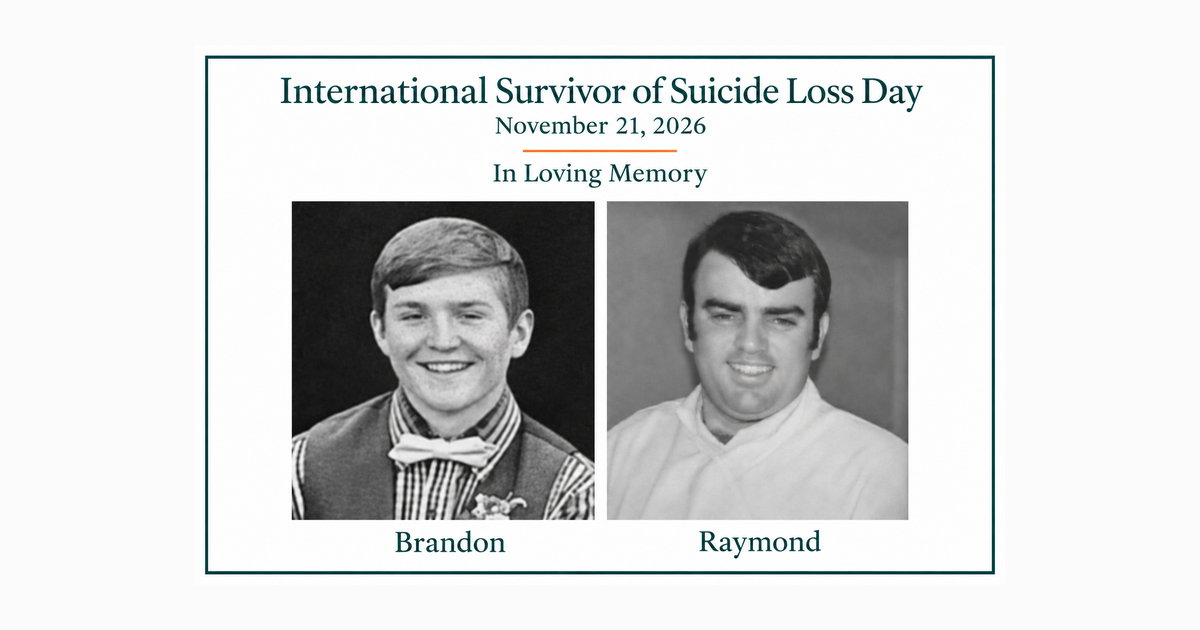
I lost my old uncle Ray to suicide on January 1, 1992. He was 47 years old.
On November 19, 2022 I lost my 24-year-old nephew, Brandon. That day was International Survivors of Suicide Loss Day. One year later, one of Brandon’s close friends died by suicide also on Survivors Day.
All of them sought professional help. All of them were deeply loved. All of them fought battles most people never saw.
I do not consider myself a victim of suicide loss. I am a survivor of it.
The victims were the people I loved who suffered from a terrible mental illness while navigating a mental health system that still has a very long way to go.
What haunts me most is not just the loss itself, but wondering how long they were struggling before anyone truly knew. Shame and stigma keep so many people quiet. People become experts at saying “I’m fine” while drowning internally.
Mental illness is an illness — no different than cancer, heart disease, or any other disease that impacts the body and mind.
I often compare it to cancer because two people can have the same doctor, the same medications, the same support, and completely different outcomes. One survives. One doesn’t. It’s heartbreaking, but it’s true.
Mental illness works the same way.
There are no guarantees. But the odds improve when people feel safe enough to ask for help and receive support without shame.
None of us are exempt from suffering. None of us are immune to disease. But we can do better — for ourselves and for each other.
As we approach International Survivors of Suicide Loss Day this year on November 21, 2026, I urge you to check in on your mental health. Not just when things completely fall apart. Daily. Consistently. Honestly.
And please check on the people you love beyond the casual “How are you?”
Ask again. Sit longer. Listen closer.
Because we are living in a world that has never been more technologically connected and emotionally disconnected at the same time.
Social media is wonderful in many ways. It helps us keep in touch. It keeps us informed. But it is not the same as human presence. It is not the same as eye contact, a real conversation, a hug, a walk together, or someone sitting beside you saying, “You don’t have to carry this alone.”
Somewhere along the way, many of us stopped truly seeing each other beneath the noise.
Losing people I love has changed the way I live my life.
I stopped waiting for the “right time” to enjoy my life.
I take the trip. I call the friend. I say the thing. I rest when I need rest. I laugh louder. I spend less time performing life and more time actually living it.
Because loss teaches you something most of us try very hard to avoid:
Tomorrow is not a guarantee.
So many people are surviving life instead of experiencing it. They keep putting joy on layaway for some future version of themselves that may never arrive.
But joy is not irresponsible. Connection is not optional. Rest is not laziness. Taking care of your mental health is not selfish.
It is part of being alive.
It also made me fiercely protective of my own mental health.
I pay attention to what I consume physically and mentally. I spend time in nature because it calms my nervous system and reminds me what is real. I meditate. I regulate stress using the same tools and techniques I teach my clients. I limit screen time. I read more. I do crossword puzzles and word searches to keep my brain engaged. I prioritize rest, movement, connection, and peace.
I care for my brain the same way I would care for any other vital organ in my body.
That is not weakness. That is maintenance. That is survival. That is self-respect.
If you are struggling right now, please reach out to someone you trust. A friend. A family member. A therapist. A support group. Call or text 988.
You are not meant to fight silent battles alone.
And if you know someone who is struggling, don’t underestimate the power of simply showing up. Sometimes people do not need perfect words. They need presence. They need compassion. They need to know they matter.
Most importantly, give yourself permission to live each day to the fullest:
Practice self-care regularly.
Create the bucket list.
Take the trip.
Watch the sunset.
Put the phone down.
Tell people you love them.
Reconnect with the friend you keep meaning to call.
Dance badly in your kitchen.
Protect your peace like your life depends on it. Because in many ways it does.
Laugh out loud.
Do one thing each day that brings you joy.
Suicide has been my greatest teacher because it taught me how precious life really is.
Not the filtered version. Not the performative version. The real one.
The messy, beautiful, painful, human experience of being alive and connected to one another.
That is the part worth protecting.
About the Author
Jayne Madigan is the Founder of Healing After Suicide, Author, Speaker, and Retreat Facilitator. Having navigated the journey of suicide loss for more than 34 years after experiencing multiple suicide losses in her own life, Jayne has dedicated her work to helping suicide loss survivors move from surviving to healing.
Through her writing, workshops, retreats, and support programs, she helps survivors honor their grief, reconnect with hope, and discover that healing is possible—even after profound loss.